Can You Put Worms in a Septic Tank? How Worm-Based Wastewater Systems Actually Work
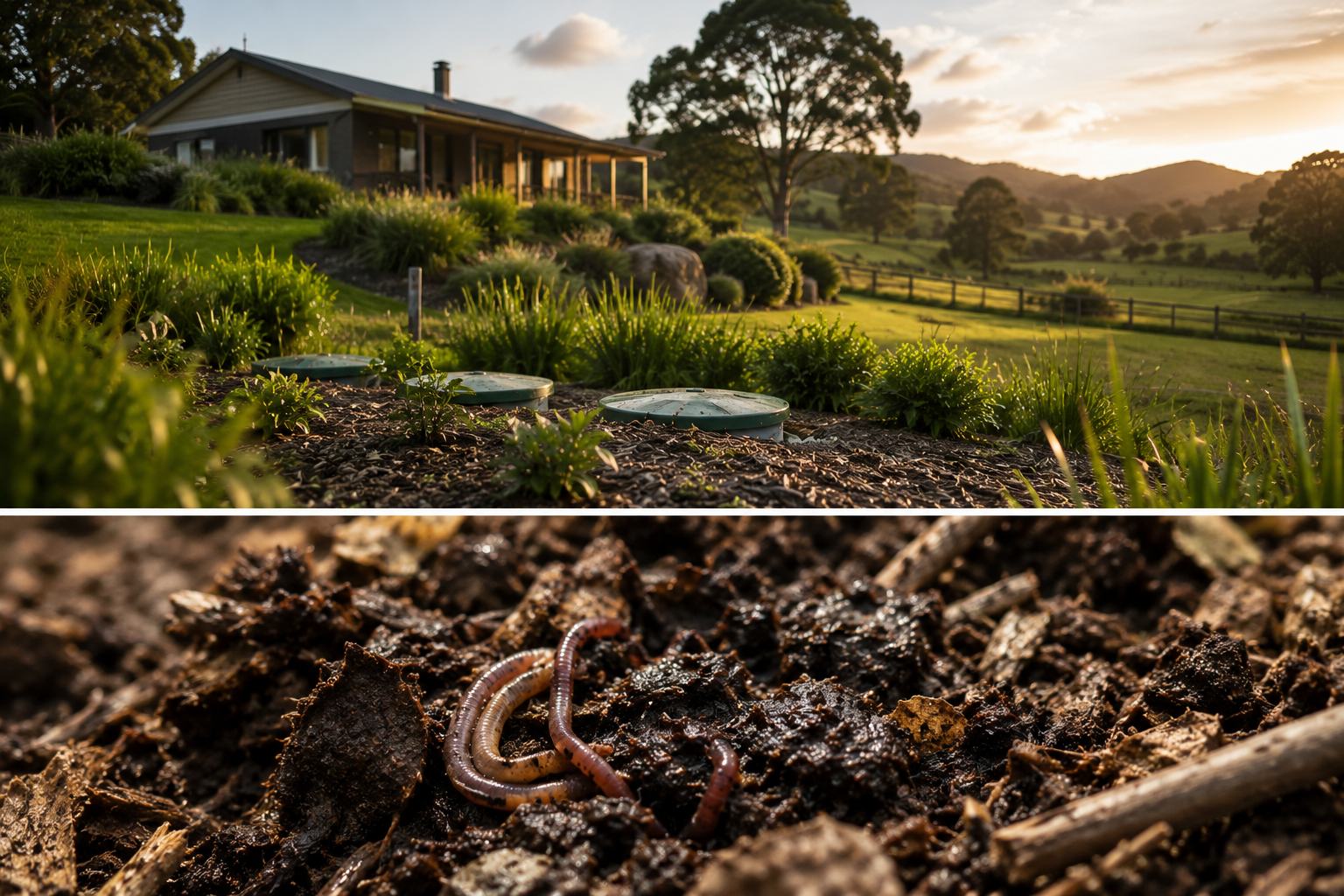
If you live rural or on a lifestyle block, your wastewater doesn't go to a council treatment plant. It goes into a tank in your paddock, and what happens next is largely invisible until something goes wrong.
Every so often someone asks us a version of the same question: "Can I just tip a bag of composting worms into my septic tank?"
The honest answer is no — and understanding why not is the fastest way to understand what worms genuinely do for on-site wastewater, and why a growing number of New Zealand households are now running systems that depend on a living worm population.
First: what a conventional septic tank actually does
A traditional septic system has two parts.
The tank. Everything from your toilets, kitchen, laundry and bathrooms flows into a sealed, water-filled chamber. Solids sink to the bottom as sludge. Fats and oils float to the top as scum. The relatively clear liquid in the middle flows out the far end.
The disposal field. That liquid runs through buried pipes into a trench or bed, where soil and soil microbes finish the job.
Inside that tank, there is no oxygen. Breakdown happens anaerobically — slowly, and with the smell you'd expect. Sludge accumulates faster than the bacteria can process it, which is why a conventional tank needs pumping out every few years, at your cost. If the sludge layer is left too long, solids carry over into your disposal field, and a blocked field is a much larger bill than a pump-out.
That anaerobic, fully submerged environment is also exactly why composting worms can't live there. Worms take in oxygen through their skin, so they need a moist, aerated environment — not a sealed, oxygen-free one. Contrary to a common belief, water alone doesn't kill them; what kills them in a septic tank is the anaerobic, sulphide- and ammonia-rich liquor and the complete absence of aerated media to live in. Either way, a bag of worms tipped into a septic tank is a bag of dead worms.
So worms aren't an additive you pour into an existing tank. They're the basis of a different kind of system altogether.
The worm alternative: vermifiltration
A worm-based wastewater system — often called a vermifilter — flips the design. Instead of holding wastewater in a submerged chamber, it trickles it through a moist, aerated filter bed sitting above the water line. That bed is usually built from woodchip, coir, bark or similar coarse organic media, and it's where the worms live.
Composting worms — the tiger and red species used in ordinary garden worm farms — do four things in that bed at once:
They eat the solids. Instead of accumulating as sludge, incoming solids become food. The worms process them into vermicast, which stays in the bed as filter media rather than building up as a layer you have to pay someone to remove. The bed does still need vermicompost taken out eventually — but years apart, rather than every few years.
They keep the bed breathing. Constant burrowing maintains air channels through the media. That keeps the system aerobic, which is a fundamentally faster and less smelly form of decomposition than what happens in a sealed tank.
They boost the microbes. Worm guts and worm castings host dense microbial populations. The worms aren't working alone — they're managing a bacterial workforce that does much of the actual treatment.
They lift effluent quality. Published vermifiltration studies report high removal rates for BOD, suspended solids and faecal coliforms. In one of the better-documented field trials — ten household "Tiger Toilets" monitored over twelve months in rural India by Furlong et al. (Waterlines, 2016) — researchers recorded a 99% reduction in faecal coliforms and only 0–10% surface coverage of accumulated faecal solids. Better effluent means less load on your disposal field, and a disposal field under less load lasts longer.
The result, when the system is designed and installed properly, is a wastewater system that produces cleaner water, smells less, has fewer moving parts, and largely stops needing the sludge pump-outs a conventional tank demands.
This isn't fringe technology. Worm-based wastewater systems are commercially designed and installed across New Zealand. Internationally, Oxfam has built and trialled more than 1,200 tiger worm toilets across six countries — including refugee camps in Ethiopia — and published best-practice guidelines for camp deployment with UNHCR funding.
Thinking about switching? Read this part first
We sell worms, not wastewater systems, so here's the unvarnished version.
You cannot retrofit worms into an existing septic tank. Converting means installing a different system. That's a real capital cost, usually recovered over years through avoided pump-outs and a longer-lived disposal field.
Consent isn't optional, and the first phone call isn't the one most people expect. A new on-site wastewater system needs a building consent from your district or city council. Separately, the discharge to land has to satisfy your regional council — in many regions that's a permitted activity if the system meets the plan's conditions, and in others it needs a resource consent. Systems are designed to AS/NZS 1547:2012, the standard cited by Building Code verification method G13/VM4. Talk to a wastewater designer or installer before you talk to anyone about worms.
A worm system is a living system, and living systems have conditions. If you're the kind of household that pours bleach down the drain by the bottle, this is not a low-effort option.
Neglect is expensive. Rebuilding a collapsed filter bed costs far more than maintaining a healthy one. The worms aren't decoration; they're the treatment mechanism.
If those trade-offs suit your property, get a quote from an installer. When your system is commissioned, you'll need worms — and that's where we come in.
Already running a worm system? Here's how to keep the population alive
This is where most of our septic-related orders actually come from. People who already have a worm wastewater system, whose population has crashed, and who suddenly need live worms fast.
What kills a worm bed
Chlorine bleach and antibacterial cleaners. The cause we hear about most often. A capful of bleach is survivable. Routine heavy use is not — it kills the worms and the microbial population the system depends on. Switch to septic-safe, biodegradable cleaners.
Fats, oils and grease. They coat the filter media, seal off air channels and turn an aerobic bed anaerobic. Scrape plates into a bin or a garden worm farm before washing.
Non-biodegradables. Wet wipes (including the "flushable" ones), sanitary products, dental floss, cotton buds. Worms can't process them and they clog the bed.
Drying out. Worms need constant moisture. Long vacancies with no water flowing through the system — a holiday home shut up over winter, a rental sitting empty between tenants — can dry a bed out and take the population with it.
Sudden hydraulic shock. A washing machine and dishwasher and three showers all draining at once can temporarily flood the bed and drive out oxygen. Spread the load where you can.
Signs the population is struggling
Smell returning to a system that was previously odour-free
Water pooling on the surface of the bed instead of draining through
Solids visibly accumulating rather than disappearing
Nothing moving when you lift the lid and check the media
If you're seeing any of these, check with your system's service technician first — the cause might be mechanical rather than biological. But if the worms are gone, no amount of servicing will fix it. The bed needs restocking.
How many worms does a septic system need?
More than a garden worm farm — this is the part that surprises people.
A kitchen worm farm processes a couple of kilos of scraps a week. A household wastewater system processes everything four or five people put down every drain in the house, every day. The bed is bigger, the load is heavier, and the starting population needs to reflect that.
As a practical starting point — and these are seeding quantities, not full operating densities:
Small system, 1–2 people, topping up after a minor knock → 500g (roughly 2,000 worms)
Standard household system, full restock after a population crash → 1–2kg (2–4 × 500g)
Larger bed, commissioning a new system, or recovering from a heavy loss → 2kg or more — get in touch and we'll work it out with you.
Two things worth knowing. First, check your system manufacturer's specification if you have it — bed volumes vary between designs, and their number beats our rule of thumb every time. Published design figures for engineered vermifilter beds run considerably higher than the seeding quantities above (on the order of 10–40g of worms per litre of filter media), which is exactly why the spec for your system governs rather than a general guide. Second, you're seeding a population, not filling a container. Composting worms breed quickly, and the population tends to be self-moderating — it settles at roughly what the food supply and the bed will support. Seeding well simply gets you to a stable, working population faster, which matters, because until the population recovers your system isn't treating properly.
We've had customers order several kilos at once for exactly this reason. If that's you, get in touch before you order and we'll sort quantity and timing.
Need worms for your wastewater system?
Shop Premium Composting Worms — $38 → Live composting worms, packed in our own premium worm castings rather than generic straw or coir, couriered anywhere in New Zealand. Available in 250g (~1,000 worms) and 500g (~2,000 worms). Ordering 1kg or more for a wastewater system? Contact us and we'll confirm quantity and dispatch timing with you.
Restocking properly
Once your worms arrive:
Fix the cause first. Adding worms to a bed that's still receiving bleach, or still choked with fat, just kills a second batch. Identify what went wrong before you restock.
Introduce them into moist media, not onto a dry or flooded surface. Open the bed, place the worms into the top layer of filter material and let them burrow down in their own time. They'll move away from light on their own.
Go easy on the household for the first fortnight. Spread out laundry and dishwashing loads while the population establishes. Minimal cleaning chemicals, and no heavy grease.
Check the media depth. Filter media breaks down over time. If the bed has thinned out, top it up with fresh woodchip or coir so the new population has somewhere to live.
Give it time. A seeded population typically takes a few weeks to establish and start multiplying. You should notice the smell settling first, then drainage improving.
The bigger picture
There's something quietly satisfying about the idea. The same species of worm sitting in a bin outside your back door turning last night's vegetable peelings into castings for your tomatoes is, in a properly designed system, capable of treating your household's entire wastewater stream — with no pump-out truck, no chemistry, and no smell.
It's the same principle we build everything around at Uncle Bob's: waste isn't waste, it's food for something. Usually a worm.
Shop Premium Composting Worms →
Questions about quantities for your wastewater system, or ordering in bulk? Get in touch — we'd rather help you get it right than sell you the wrong amount.
Sources & further reading
Furlong, Gibson, Oak, Thakar, Kodgire & Patankar (2016), "Technical and user evaluation of a novel worm-based, on-site sanitation system in rural India", Waterlines 35(2)
McBride & Muturi (2017), Tiger Worm Toilets: Best Practice Guidelines for Refugee Camps — Oxfam / UNHCR
Vermifilter and vermifilter toilet technical overviews — Wikipedia
On-site sewage systems — Building Performance, MBIE (building.govt.nz)
AS/NZS 1547:2012 — On-site domestic wastewater management (cited by NZ Building Code G13/VM4)
Septic tank maintenance guidance — Northland Regional Council
NaturalFlow, Wormsmart and AutoFlow — New Zealand worm-based wastewater system suppliers
